SEC filings suggest press releases and executive quotes are increasingly written with AI
We analysed 112,174 press releases filed with the SEC since 2018. AI tells spiked in 2025, with executive quotes changing the most.

Aaron Stillwell
Founder, AssetRoom
November 16, 2026
10 min read
Key statistics
112,174
Press releases filed with the SEC by 2,453 US-listed companies from January 2018 to 21 September 2026, analysed for this study.
2.9x
Rise in the em dash rate inside quotes in 2025, from 0.18 to 0.54 per 1,000 words. The rest of the release rose from 0.05 to 0.08.
159%
Increase in the share of press releases with an em dash inside a sentence of newly written text: 9.7% in 2026, against an average of 3.7% in 2018–24.
139 to 443
Companies that used an em dash in a quote, 2024 to 2025, out of about 2,300 that quoted anyone.
When a public company reports its earnings results, hires a new CEO or CFO, or suffers a security breach, it puts out a press release. Investors, analysts, journalists and of course the general public, subsequently read these releases, not just out of interest, but to determine how much the company is worth, what the news might mean for the value of the company moving forward, and so forth.
We can learn a lot from the writing a company puts out. Warren Buffett became famous, not only for the renowned performance of Berkshire Hathaway’s stock, but for his plain English, no-nonsense approach to communicating with the market.
There’s probably an interesting quandary here that many folks are thinking about today across various professions. When is it fine to copy and paste from ChatGPT in the vein of “good enough” and being productive, vs. when does work deserve being written up with care and thoughtfulness? I’m sure a lot of people interested in public companies - particularly shareholders - would like to think that management would continue to write thoughtful announcements about their business, and not digress to LinkedIn-style AI slop.
Perhaps that’s a harsh take, and maybe a more charitable one is that public company officers should be as efficient as they can, but it’s nonetheless something worth looking into. Many folks have developed an intuition about what AI written content looks like (see LinkedIn’s “Seems like AI slop” button).
The logical question is, can we see evidence of AI-style writing in the press releases of public companies? We examined 112,174 press releases from January 2018 to 21 September 2026, from 2,453 US-listed public companies with a public float of at least $300 million, to see what we could observe.
Em dash usage rose drastically in 2025
One casual observation of AI written content is the prominence of the em dash. I’m personally convinced that despite its ubiquity in 2026, most people wouldn’t be able to find it on their keyboard.
A simple search for em dashes in our press releases shows a sharp change in 2025.
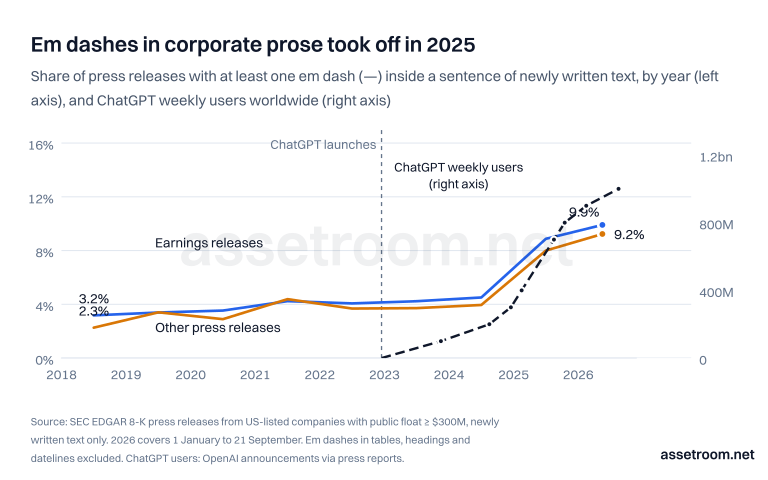
Between 2018 and 2024, only 3-4% of press releases had an em dash inside a sentence of newly written text. In 2025 and 2026, that figure jumped to 9 and 10% respectively.
Examining executive quotes in more detail
A press release often has multiple parts. Financial tables, safe-harbour paragraphs and so forth - often templatized and reused, so we strip those out before measuring anything. What’s left is the newly written text, and within that, what’s notably different are quotes from company officers - for example, the CEO. You might expect AI to show up in the routine parts of a release rather than in a statement (supposedly) written by a person of significance.
What’s interesting then, is how our research shows the opposite. Comparing only newly written text, the quotes changed far more than the text around them.
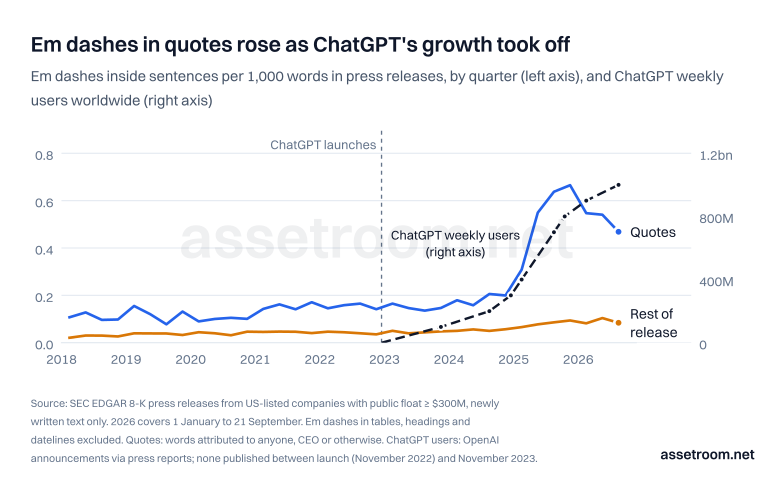
In 2025, the rate of em dash occurrence in quotes nearly tripled, from 0.18 to 0.54 per 1,000 words. That covers everyone a release quotes: chief executives, finance chiefs, chairs and partners. In the rest of the release, the rate rose only from 0.05 to 0.08.
Earnings releases demonstrate this most clearly. Before 2025, their quotes already had about three times as many em dashes as the text around them. Since 2025, they have more than six times as many.
This change appears broad and not isolated to a handful of companies. In 2024, 139 companies used an em dash in a quote; in 2025, 443 did. That is a rise from 6% to 19% of the companies that quoted anyone.
Supporting evidence - increases in specific vocabulary
A second way to look for AI-written text is to count words that LLMs use far more often than people do. Kobak and colleagues developed this approach in a study of 15 million scientific abstracts (Science Advances, 2025), where they found words such as “delves”, “showcasing” and “underscores” surging after ChatGPT was released. We took three words from that research: “underscore”, “underscores” and “underscoring”. We found ten more by applying the same method to press releases. For every word, we projected how often it should appear in 2025 and 2026 from its trend in earlier years, and flagged words that appeared at least twice as often as projected.
Most flagged words were tied to news, such as “tariffs”, so we had them sorted into style words and news words by an LLM that saw only example sentences. From the style words that rose most, we picked ten: “reshaping”, “reinforcing”, “sharpening”, “decisively”, “grounded”, “deepen”, “deepening”, “intersection”, “redefining” and “strengthens”. Because we picked these ten for rising, their rise is partly built in, so we treat them as supporting evidence.
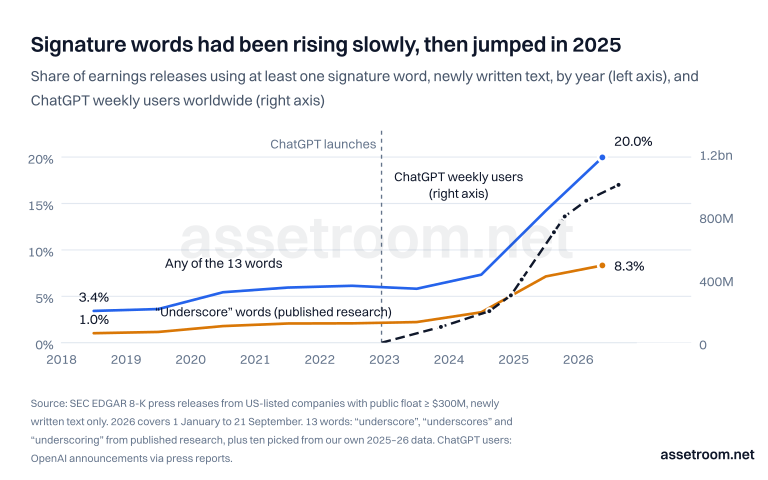
Together, the 13 words jumped at the same time as the em dash. The share of earnings releases using at least one of them had been creeping up since 2018, from about 3% to 7% in 2024, and then reached 20% in 2026. The three words from published research rose from 3% in 2024 to 8% in 2026.
Tech changed most, energy and utilities least
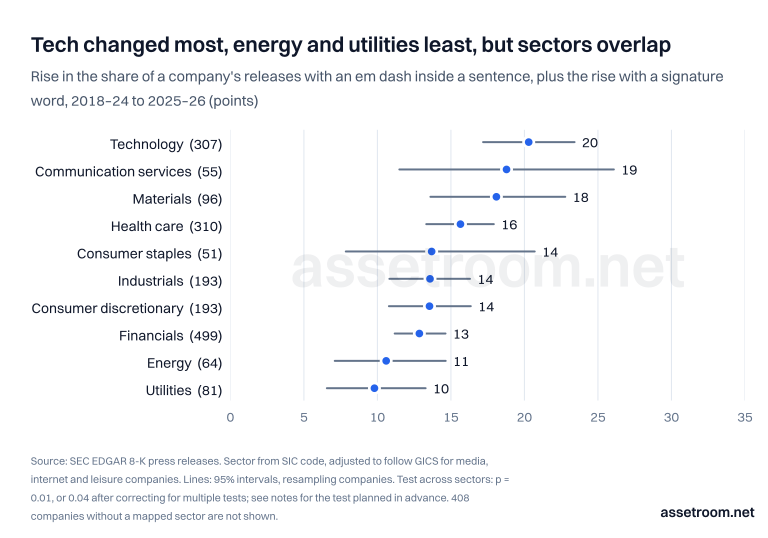
Technology and communication services companies changed their writing most; energy and utilities least. That lines up with what many might expect from AI adoption, with tech and related industries leading the way. The differences are significant for the sectors in the chart, but not in the test we planned in advance, so treat them with some caution.
Conclusion
Looking across 112,174 press releases, the way public companies write changed noticeably in 2025, in ways that we’d expect if more of it were being written with AI. Where it shows up most clearly is in quotes from executives.
To be clear, none of this proves AI wrote any particular release. An em dash or a word like “reinforcing” doesn’t mean much on its own, and AI used with some careful editing may not leave a trace at all. But a shift this sudden, across companies in many sectors, needs an explanation. It isn’t a change in filing software: the rise shows up with every large filing agent and among companies that kept the same one, and it is far larger in quotes than in the rest of the same releases. It isn’t new companies joining either, as it holds among companies that filed in every year. AI is the obvious suspect.
If more companies lean on the same handful of tools and their written announcements get harder to tell apart, then for folks interested in following, researching or investing in public companies, the things you can’t get from press releases - earnings calls, answers to analysts’ questions, meeting management in person - may matter even more than they do today.
Warren Buffett’s shareholder letters stood out because they were plain, consistent and clearly his. He said he wrote Berkshire’s letters with his sisters in mind: smart, but not finance people. It’s too soon to say whether the changes we found will last, but perhaps they’re an early sign that we’ll see less of the candid, consistent and personal writing that set apart some of the best-run companies of recent decades, from Buffett’s Berkshire to Bezos’s Amazon.
Notes & References
Data
Press releases attached to 8-K filings on SEC EDGAR, January 2018 to 21 September 2026, taken from Exhibit 99.1, so slides, supplements and call transcripts filed alongside are left out. Earnings releases are Item 2.02 (74,533 releases); other press releases are Items 7.01 and 8.01.
The companies are those listed in the US in 2026 with a latest public float of at least $300 million, as reported on their 10-K cover pages. 121 of them are foreign companies listed in the US. Companies delisted or acquired before 2026 are not included.
What we counted
Newly written text only. We removed financial tables, datelines and any sentence a company had already used in its previous release, and kept releases with more than 200 new words.
One large filing agent stored punctuation in an old Windows character set, which we converted before counting.
Em dashes
An em dash counts only when it sits inside a sentence: at least three words on each side, no figures next to it, not in a dateline, and not part of a heading, table label or contact line. About 28% of em dash characters pass.
The rise holds among the 1,743 companies with earnings releases in every year.
Quotes
A quote is 40 or more characters inside double quotation marks that someone says. It counts when a speaker is named just before or after it, when it continues the previous quote, or when it is a statement of 150 or more characters in the first person. Quotation marks around defined terms, report titles and legal wording don’t count. About 11% to 14% of quoted passages each year are of that kind.
We count quotes from everyone together, because a release often names the speaker only once across several paragraphs of quotes.
On 98 randomly chosen quotes, labelled by an AI model, the rule agreed on all 98.
Em dashes in quotes and in the rest of the release are counted with the same inside-a-sentence rule.
Signature words
Following Kobak and colleagues, we projected each word’s yearly frequency from its earlier trend and flagged words appearing at least twice as often as projected. An AI model sorted them into style words and news words, seeing only example sentences.
We picked ten of the style words that rose most in 2025–26, so their rise is partly built in. The three “underscore” words come from published research.
Sectors
Sectors come from SIC codes, adjusted to follow the GICS standard for media, internet and leisure companies. The 408 companies whose codes don’t map to a sector are left out.
For the sectors in the chart, the differences are significant: p = 0.01, or 0.04 after correcting for the other tests we ran. The test we planned in advance used an earlier sector grouping and counted every em dash, not just those inside sentences; it gave p = 0.08, or 0.16 after correction, which is not significant.
Charts
Ranges are 95% intervals from resampling companies, so a few prolific filers can’t drive the result. ChatGPT users are weekly active users as announced by OpenAI; none was published between launch in November 2022 and November 2023.
References
Kobak, D., González-Márquez, R., Horvát, E.-Á. and Lause, J. (2025). “Delving into LLM-assisted writing in biomedical publications through excess vocabulary.” Science Advances 11(27). doi:10.1126/sciadv.adt3813
US Securities and Exchange Commission. EDGAR filings and XBRL company data, data.sec.gov.
OpenAI. Announcements of ChatGPT weekly users, November 2023 to August 2026, as reported in the press.